

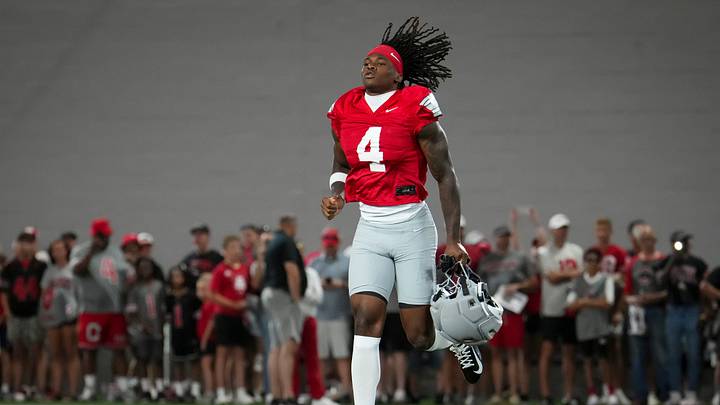
When you think of an Ohio State offense, what do you think of? What do those three words spark in your brain? For some, it might be three yards and a cloud of dust, going back to the Woody Hayes era. Others may think of the quarterback run and the H-back days of Urban Meyer.
If you’ve watched Ohio State football during the Ryan Day era, you think of an elite passing offense. Since 2021, Ohio State has had six wide receivers and two quarterbacks drafted in the first round. They’ve got one of each coming to the NFL in the 2027 draft if all goes well this season.
However, with the departure of wide receivers coach Brian Hartline to South Florida, the receiver room looks a lot different. Gone are the days of Marvin Harrison Jr. and Emeka Egbuka combining for ten total catches in their freshman seasons and then becoming first-round picks.
Jeremiah Smith is the best player in the country and is at Ohio State for one more year. The rest of the receiver room is a mix of low-ceiling veterans and young players. How will head coach Ryan Day and offensive coordinator Arthur Smith build an offense that is effective in different ways?
The sport of football has always and will always be about the line of scrimmage and quarterback play. Ohio State is set there when it comes to personnel, but there are fair questions about quality. Julian Sayin returns for his second year as a starter after being a Heisman Finalist in his first year.
There was a long stretch of last season where Sayin looked like the best quarterback in the country. He was mostly held back in the opener against Texas, but for the next seven games he was the best quarterback in college football. Over that stretch, he completed 82.3% of his passes for 2,062 yards with 22 touchdowns and three interceptions with three sacks taken.
The final game of that stretch was Sayin’s best game of his career so far, when he went 20/23 for 316 yards and four touchdowns against Penn State. What happened in the final six games of the season leaves some doubt coming into 2026. Things were a tad bit clunkier in the three-game stretch against overmatched opponents in Purdue, UCLA, and Rutgers as Ohio State was dealing with injuries at receiver.
Carnell Tate missed all three of those games, and Jeremiah Smith missed three quarters of the UCLA game and the Rutgers game. Those guys came back in the Michigan game, and Sayin looked more like he did most of the season. He started 0/2 with an interception, and after that went 19/24 for 233 yards and three touchdowns.
In the last two games of the season against Indiana and Miami, it was a different story. Ohio State lost both games, with Sayin completing just 67.2% of his passes for 545 yards with 2 touchdowns and three interceptions while taking a whopping ten sacks.
Sayin is going to need to take another step forward in 2026 with Carnell Tate gone. Tate’s absence will require Sayin to involve multiple receivers and use the whole field, which is something we didn’t see as often in 2025. He will also need to play faster, and maybe use his legs a little more to help avoid sacks in big games. Sayin’s sack-adjusted rushing totals in 2025 were just 26 carries for 66 yards. Sacks aren’t always on the quarterback, however.
Ohio State is banking on internal improvement on the offensive line. They return four of five starters from last year, while not adding any significant transfers. They will be an experienced group on the starting line. Carson Hinzman at center is going into his fifth year of college football; Luke Montgomery and Austin Siereveld are both going into their fourth year.
Those are their three guaranteed starters. They will also have Phillip Daniels in his fourth year and Ian Moore in his third year competing for spots. It’s not a bad strategy, as offensive line play in college has a lot to do with development and chemistry.
Ohio State’s offensive line was fine in 2025 and was shaky in 2024 before the playoff. Ohio State’s 2024 offense had three first-round wide receivers and two top 50 picks at running back. The 2025 team was similarly stacked at receiver. The 2026 team will not be like that, which makes offensive line play much more important.
The hiring of Arthur Smith was a clear indication that Ryan Day wants his offense to be even further NFL-ified. Building an offense around wide receiver play is a strategy that we see in the pros, including the NFL team that I write about, but it is still pretty unconventional.
A trend at the professional level is the use of tight ends. We saw Ohio State dabble in the use of heavier sets in 2025. Last season, when Smith was the offensive coordinator in Pittsburgh, the Steelers were second in the NFL in 13-personnel usage.
This hire is an indication that Ohio State wants to continue to use those sets as part of their offense. The question is really about whether or not they are good enough to do it. If they could’ve convinced Max Klare to stay for his final year, I would be very open to this, but without him, I question the personnel.
Transfers Hunter Welcing and Mason Williams were both key contributors to their offense last year at Northwestern and Ohio, respectively, but they are playing at a higher level at Ohio State. They have Bennett Christian back after he played a key role in blocking out of heavy sets.
They also have Nate Roberts going into his sophomore season. Roberts was used in a fullback role at times in 2025 as a freshman, and it didn’t really go so well, but it was an indication that the coaching staff likes the player. I don’t know what role it will be, but I expect Roberts to be a big part of the offense this season.
The wide receiver group is obviously a step down from past seasons. For the first time since 2018, Ohio State will not have multiple future first-round picks in its receiver room. I’d say this is the worst OSU receiver room since 2019, even with Jeremiah Smith, who is the best player in college football and will be a top 5-10 receiver in the NFL as soon as he steps on the field.
This receiver room actually profiles similarly to that 2019 room. One star, a reliable slot, and a placeholder for a freshman on the outside. In 2019, you had Chris Olave as the star, with K.J. Hill in the slot, and Austin Mack and Binjimen Victor holding it down until Garrett Wilson was ready. In 2026, you’ll have Jeremiah Smith as the star, with Brandon Inniss and Devin McCuin creating K.J. Hill in the aggregate in the slot, and Kyle Parker holding it down until Chris Henry Jr. is ready.
Ohio State has to find creative ways to get Jeremiah the football. We’ve seen games over the past two years, particularly the Michigan and Texas games in 2024, where teams have made it their sole mission to take him away. The Buckeyes won’t have as many counters to that this season as they have had in years past.
In 2024, they had two top-50 picks at running back and two future first-round receivers outside of Smith. They didn’t have all that in 2025, but they at least had Carnell Tate. In 2026, they’ve got none of that. We’ve seen Smith’s role change in the Ohio State offense as the personnel changes.
In his freshman year, his average yards per reception were 3 yards higher than it was in his sophomore year, and he had three more touchdowns, albeit in three more games. In his sophomore year, he had eleven more catches, but 83 fewer yards, again noting the games played difference.
His reception share went from 24.6% in 2024 to 28.9% in 2025. I’d expect the numbers to go even further in that direction. Higher target share, more total catches, fewer yards per reception. I’d expect to see some screen passes, quick throws, maybe even some carries to get him involved. Smith has 9 total carries in his first two seasons at Ohio State. Of course, if a team plays man-to-man coverage, he is still a cheat code for downfield shots, but I don’t expect teams to be very willing to give that up.
Now let’s add a little more perspective to the receivers. For the first time in a long time, it might not be the best receiver room in America. It might not even be the best in the Big Ten. It’s a three-team discussion for the best room in the country, and I still think the Buckeyes belong there, although I would put them third.
The other two are both on Ohio State’s schedule. The Texas Longhorns have the best top two in the nation, with Auburn transfer Cam Coleman joining Ryan Wingo in Austin. The Oregon Ducks have the best top three in the nation, with Evan Stewart returning from his torn patellar tendon that kept him out all of last season to join Jeremiah McClellan and sophomore Dakorien Moore.
Ohio State, of course, has the top one in the nation in Jeremiah Smith. This position is still a clear strength of the team, even though it isn’t necessarily a room that would rival many in the NFL as it has been in the past.
While the offense is going to look very different from much of what we’ve seen in the Ryan Day era, the Ohio State standard still applies. This should be one of the best offenses in the Big Ten. How well it translates to the level of football needed to win big games in the Big Ten and the playoff will depend on the progression of Julian Sayin.
I am a big believer in Julian, and I think he will be taken very high in the NFL draft in April. If that is the case, Ohio State will be right back in contention to win their second national championship in the past three years. If not, they will still be a good team, because their baseline is already high, but I’m not sure they’ll have what it takes to beat College Football’s best.
 Add us as a preferred source on Google