

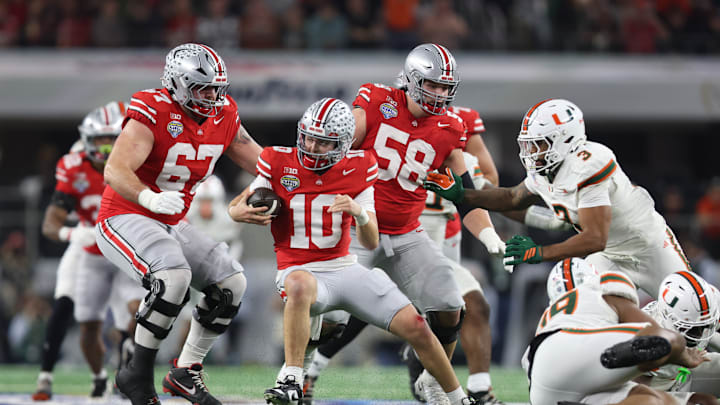
In the first 12 games of the season, Ohio State had allowed only six sacks. In the last two, they allowed 10. His offensive line did him no favors, but Julian Sayin struggled, and most of that struggling fell on the freshman quarterback’s shoulders.
Plenty of the problems with the pressure Miami put on him were because he held onto the ball far too long, and even more of his problems were simply not seeing the field and open receivers.
Three plays painfully illustrate this. After Jeremiah Smith caught a 59-yard pass that put Ohio State in Miami territory while trailing 7-0, Julian Sayin missed a wide-open touchdown that he appeared to be looking right at. Max Klare is open in the center of the field for a near-certain touchdown, but Sayin holds on to the ball and ends up eating a sack.
C’mon Julian… https://t.co/wPmfEtPOlz
— Ohio State Football Fan Page (@OhioStFootball) January 1, 2026
Disaster struck on the very next play, when Sayin floated a bubble screen pass that Jeremiah Smith completely missed his block on (his lone mistake of the game), which was intercepted and returned for a touchdown. Two plays and a 14-point swing in a game that ended up being decided by 10 points. It got worse from there.
On 2nd-and-10 with the ball at their own nine, Ohio State dials up a perfect play call. Using motion to give Sayin time and get Carnell Tate open down the center of the field for what would have been a 91-yard touchdown pass. Sayin doesn’t pull the trigger and throws an incomplete pass. 21 points for the Buckeyes were gone in three plays.
The offensive line and blocking struggles, and Sayin’s bad game, could have easily been footnotes in a come-from-behind win had Ohio State’s offense not continued to bang its head against brick walls. For reasons that are murky at best, all season long, Ryan Day, Brian Hartline, and Keenan Bailey have wanted a slow-paced offense.
Earlier in the year, it was theorized and suggested that this was a deliberate strategy to reduce wear and tear on Ohio State’s players. Ryan Day had insisted earlier in the year that when they needed to turn on the gas, Ohio State would.
Jullian definitely wasn’t seeing the field last night. Was a rough one for him. He’s young. He will learn and be better but this was 1 of probably 5-6 that would’ve changed the game. https://t.co/trVh92PraN
— Matt Finkes (@MattFinkes) January 1, 2026
They even had moments in this game. Their two-minute drill before halftime gave their offense life, and when the no-huddle was sprinkled in during the second half, Ohio State put together two touchdown drives. But like with the red zone struggles against Indiana and in the past seven seasons, Ohio State still hasn’t overcome its challenges with clock management.
In moves reminiscent of their repeated running up the middle in The Game in 2024, the Buckeyes kept letting the clock drain. They not only slowed themselves down and allowed Miami to maintain their lead with this, but they also let the Miami defense rest and regroup. Nowhere was this worse than when Ohio State had a seven-play, six-yard drive in the fourth quarter that took 4:20 off the clock before the Buckeyes punted.
The most frustrating thing for Ohio State is constantly seeing problems like this plague fantastic teams for an entire season (and, in some cases, across multiple seasons) and end up being the only thing holding them back from achieving key victories and forming a dynasty like none before. Ohio State, its coaches, players, program, and fans are too good for them to keep standing in their own way. Unfortunately, it is starting to become as much a part of Ohio State’s identity as the scarlet and gray, Script Ohio, and the Horseshoe.
 Add us as a preferred source on Google