

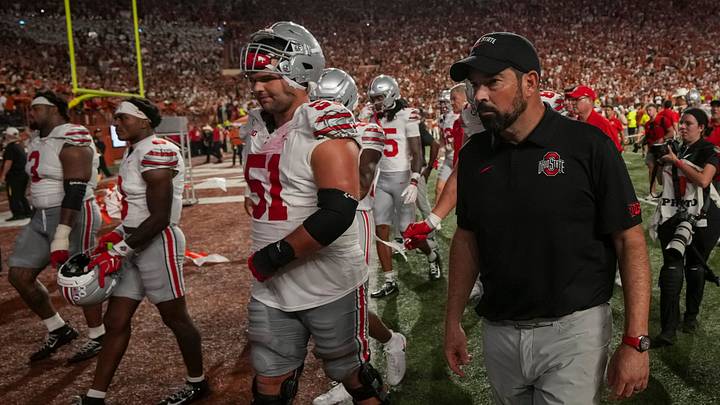
“No one said this had to be a close game.” That’s what Urban Meyer told his team at the half of the 2014 Big Ten Championship. Ohio State led that game 38-0 at the half and won 59-0. Ryan Day said before the game against Texas and at the half of the game against Texas that it would be a ‘four-quarter game.’ When the Buckeyes led 20-3 at the half and had dominated, and would lead 23-3 early in the second half, many Ohio State fans were asking one question: why? Why did it have to be a four-quarter game?
All the numbers except the most important one were in the Buckeyes' favor and an improvement over their previous two games against Texas. Ohio State had 94 rushing yards after only having 77 last year, and 81 the year before. They had 278 passing yards, after only 126 last year and 289 in 2024. 372 total yards of offense, compared to 203 in 2025 and 370 in the Cotton Bowl. 23 points, instead of 14, and the 28 in the Cotton Bowl were more only due to a defensive touchdown.
The in-depth numbers were less kind. Ohio State only had 129 yards of offense in the second half, and only 49 in the fourth quarter. In their three games over the past three seasons, the Buckeye offense has only scored 17 points against Texas. The recent woes are even worse.
In their last three games of Power Four football, Ohio State has been held without a touchdown in three of its six halves. They had a field goal against Texas in the second half, were shut out in the second half against Indiana, and were scoreless in the first half against Miami.
Julian Sayin got jumpy in the second half. His timing was off on the play when he missed a wide-open Devin McCune. Ohio State only compounded his nerves instead of calming them. He would miss a wide-open Brandon Inniss on a seam route instead, forcing it to Jeremiah Smith (to be fair, that’s a good security option), who was essentially quadruple-covered. This would force Ohio State to settle for a field goal that would make the game 23-3, but that would be all she wrote for the offense. Their next three possessions were abysmal.
Another Fourth Quarter Failure
They’d get six yards on three plays, and punt. Then one yard on three plays, and punt. Finally, when they were able to slightly move the ball, thanks to Sayin finding his tight end, they’d again implode. With 1st and 10 at the Texas 33, Bo Jackson would run up the middle for a seven-yard gain, and the offense looked like it might come to life.
Then they dialed up a play that has stopped them more than any opposing defense ever could hope to. It was stopped on their first red-zone possession, forcing a huge third down. Shoot, it stopped them last week against Ball State!
It’s the toss to the halfback, running outside (when the running game had only been working inside all game) to the boundary. It resulted in a nine-yard loss in the first quarter, and a one-yard loss here, turning 2nd and 3 to 3rd and 4. Surprised by this result, and they were the only ones in America who were, the offense went to old reliable on third down.
But instead of throwing to the sticks on something simple, they threw to Jeremiah Smith at the two, into a tight window that Sayin again missed. Ohio State trotted out a new kicker, trying to make a high-pressure field goal, but experienced the same result.
The final cherry on top of this crap Sundae was that, when Texas, on their third straight punishing drive against a worn-out defense, got the ball to the Ohio State one-yard line and had 1st-and-goal to go. With 1:23 left on the clock and one timeout remaining, Ohio State put the pressure on a defense that had given up 235 yards in the quarter and chose them to decide the game for them.
Instead of letting them score and getting the ball back with about 1:20 on the clock and needing a field goal for the lead. The tired defense gave way, and Ohio State would have only 0:25 left, and the worst fourth-quarter blown lead in school history was complete.
The horrific offensive showing was worse than it looked. Nearly %75 of Ohio State’s offensive plays were in Texas territory, 8 of their 11 possessions got into Texas territory, and they reached the Texas 30-yard line seven times. They got only 23 points and a historic loss out of that.
It was historic, and not just because of the team record for the largest blown fourth-quarter lead. Since 2003, #1-ranked teams were 223-0 when leading by 17 or more points. 2026 Ohio State is the 1 in 223-1. When leading by 17 or more at halftime, Ohio State was 309-0, 2026 Ohio State is the 1 in 309-1. When heading into the fourth quarter with a 20-or-more-point lead, Ohio State was 365-0.
While those were historic, blowing fourth-quarter leads is not new since 2019. They did against Clemson that year in the CFP; they blew a 14-point fourth-quarter lead against Georgia in 2022 in the CFP; and they blew a 20-point lead against Texas in the final quarter. Sometimes a picture is worth a thousand words.
Ohio State is 0-3 in these three games.
It’s a common theme. As is kicking failures late in tight contests.
Ohio State is 0-4 in these four games.
The ultimate responsibility for these failures lies with the only way they can ever be changed, and that’s at the top of the program. Until that happens, these kinds of losses will become a part of the team’s identity whether they like it or not, and that will only increase their frequency until something in some direction gives.
 Add us as a preferred source on Google