

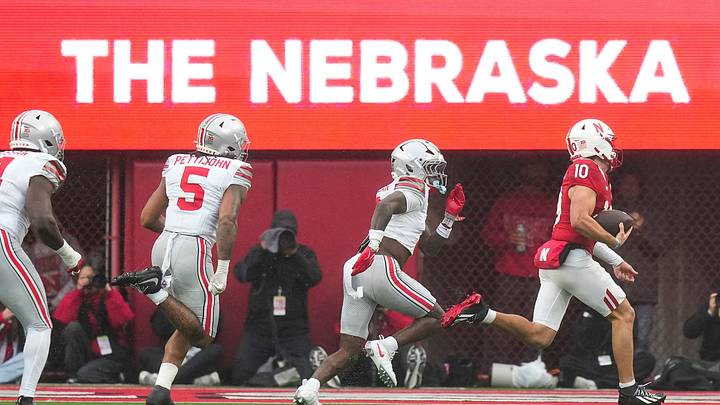
The Buckeyes' defensive stats and 7-4 record don’t add up
OSU came into the game allowing 92.7 yards per game on the ground. That was 12th in the country. The Buckeyes’ 12th-best rushing defense allowed 176 yards on the ground. The passing defense was 40th, allowing 193.4 yards per game, and they were at their usual. They allowed 200 yards, and that only changes their average to an even 194 per game, and their ranking actually improves to 35th in the FBS.
The total defense was 13th, allowing 286.1 per game, and they gave up 90 yards more than their average. After allowing 376 from Nebraska, their average is now 294.3 per game and drops to 18th in the nation.
Scoring defense, the most important stat in the game, took the biggest hit. They were at 18.4 per game, which was 19th in college football. Giving up 31 to Nebraska bumped that average to 19.6 and dropped them out of the top 25 to 28th in all of college football.
The defense needs to improve on everything. They got one sack on an offense that ranks 58th in sacks allowed. When you play this poorly as a defense, there was nothing noteworthy done well, no play of the game, and no player of the game. That’s the only real conclusion when you give Nebraska their first ranked win in over 10 years and snap their 31-game losing streak against ranked teams.
Dunked on by struggling foes
This defense was awful on critical downs. Nebraska went 10 of 16 on third down and 2 of 2 on fourth down. The defense couldn’t get a stop in a factory that makes metal red octagons. Unless the Huskers really light up Iowa on Black Friday, Ohio State will be the only Big Ten team with a winning record that Nebraska scored more than 17 points on.
Against other Big Ten teams with a winning record, Nebraska averages 13.5 points per game. Against this mirage of a defense, they more than doubled that. Nebraska scored 31 on both Ohio State and Rutgers in back-to-back weeks. Rutgers ranks 123rd in college football in scoring defense. Rutgers could hold Nebraska to 31, as Ohio State did, and they gave up 37 to UMass.



Defensive stat of the game
Ohio State hasn’t won a game where an opponent scored 24 or more points since 2022. They’re 0-5 under Matt Patricia when an opponent hits that magic number or better. The last time they overcame that hurdle was against Maryland in CJ Stroud’s last win, when Dallan Hayden ran for 146 yards and three touchdowns. In Ryan Day’s time at Ohio State, the Buckeyes are 9-12 when they allow 24 or more points, with all 9 victories coming in the first four years.
The bottom line
Everyone points to Julian Sayin’s injury for Ohio State’s troubles, but Sayin didn’t play on this side of the ball. Ohio State’s problems are from the top down. Ohio State’s stars carried them last year. Of course they’re missed.
No team wouldn’t miss Caleb Downs, Sonny Styles, Arvell Reese, Kayden McDonald, and Caden Curry. But Eddrick Houston, Kenyatta Jackson Jr., Payton Pierce, Jermaine Mathews Jr., Devin Sanchez, Riley Pettijohn, and the rest are good enough to have them ranked in the top 40 defensively against the run, the pass, in total defense, and in scoring defense.
Before Sayin’s injury, they were giving up 13.7 points per game, which would put them in the top five right now, ahead of Georgia. Since Sayin’s injury, the defense is giving up 30.3 points per game. Remember that Rutgers defense that’s 123rd? They’re giving up 31.6 points per game.
The offense, statistically speaking, has only slightly dipped. With Luke Fahey at quarterback, they’re averaging 25.5 points per game. With Sayin, when you remove the inflation of 56 against Ball State, 59 against Kent State, and 45 against Maryland, they were averaging 28.8.
Comparing his four games against Texas, Iowa, Illinois, and Indiana is fair to Fahey’s four against USC, Northwestern, Nebraska, and Oregon. If an offensive player’s injury can take a defense from being better than Georgia to worse than Rutgers with only a field goal dip in output from the offense, the problem is entirely in the hearts and minds of the team.
There are grown men being paid millions of dollars a year to keep those on track, including the head man who makes over 12 million a year and is 7-6 in his last 13 games. That’s where the Bucks stop.
 Add us as a preferred source on Google