

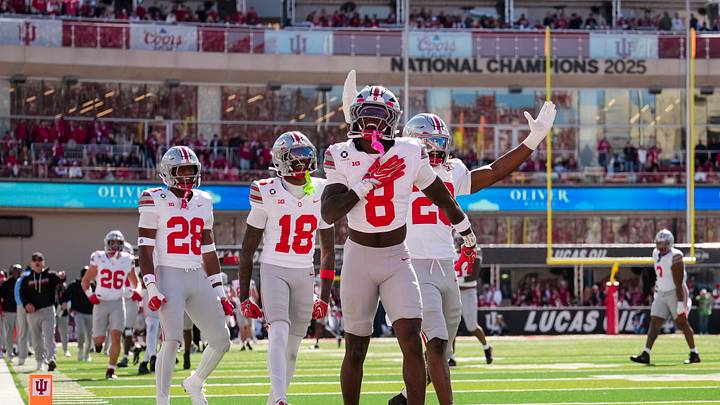
The Buckeye defense was far from perfect, but they did enough to get a desperately needed win. The win was only made that much more urgent by the OSU offense losing starting quarterback Julian Sayin. The defense will no doubt be leaned on more with a new quarterback going forward, so they needed the win for themselves as much as they did for the offense and the whole team.
The passing defense started the game averaging 150.6 yards per game. Indiana put up 296, the highest OSU has allowed this season, and Ohio State now averages 171.4 passing yards per game. The rushing defense has been more stout for Ohio State, especially as of late.
They were allowing 94.5 yards per game and held Indiana to 73 rushing yards. Their average is now at 91.4 yards per game. The defense improved on turnovers, too. They came into the game with eight, averaging 1.3 per game. They forced two and improved to 1.4 per game with 10 overall this season.
The most important stats in football were good for the defense, too. Ohio State was allowing 246.8 total yards per game and allowed 369 to the Hoosiers, moving that average to 264.3. Their scoring defense is even better. Coming into the game, they allowed 13.2 points per game and, after giving up 15, allowed only 13.4 per game.
What the defense needs to improve on
Charlie Becker again had a big game against the Buckeyes. Like in the Big Ten championship game last season, Becker was gobbling up the Ohio State secondary. I’m torn between acknowledging what an elite receiver Becker is and the fact that Ohio State should have covered him and Nick Marsh much better.
Marsh and Becker were great in single coverage on the outside, finishing the game with 12 catches for 222 yards and a touchdown, and were inches from adding a 27-yard go-ahead and likely winning touchdown to the tally.
They also still need to find a way to rush the passer better. The Buckeyes got to Josh Hoover for only a single sack. The Hoosier offensive line is likely the best Ohio State has faced, but with that in mind, they need more pressure moving forward. It’ll be tough, as their best pass rusher, Kenyatta Jackson Jr., was seen limping after the game.
What the defense did best
They bent but didn’t break. Holding a top-five team to 369 total yards and only 15 points is good, no matter how it’s done. Even if it’s some luck, like Nick Marsh’s catch with less than 90 seconds to go being just barely out of bounds. The defense pulled off the nearly miraculous here when, just last month in Texas, they didn’t. Give them credit for finding a way to get the win.
Defensive play of the game
Jaylen McClain made the best play of the game when he was brought by Matt Patricia on a safety blitz. McClain came free, got to Josh Hoover, and got a strip sack. The fumble was recovered by linebacker Riley Pettijohn. McClain looked a lot like his 2025 partner at safety, Caleb Downs.
Jaylen McClain with the strip sack and Riley Pettijohn with the recovery! Huge play by the Buckeye safety! Looked like Caleb Downs on that one!!! https://t.co/0NLTM5kbby
— Phillip Riggs (@phillipriggs85) October 17, 2026
Defensive player of the game
Speaking of Jaylen McClain, he and the other two Buckeye safeties were the best players on the field for the Ohio State defense. McClain, Earl Little Jr., and Jay Timmons were fantastic in defending the middle of the field against both the pass and the run.
It’s strange that, without much, the corners on the outside were struggling to cover Becker and Marsh, and Ohio State didn’t give them more help from McClain, Little, and Timmons. Indiana always had at least two guys on Jeremiah Smith, and after what he’s done in the past two games, if the Buckeyes ever see Charlie Becker again, that’s what they need to do to him.
Little had eight tackles and a pass deflection, Timmons had seven tackles and broke up two passes, and McClain had four tackles, a sack, a tackle for a loss, and a pass breakup.
Deuces were wild for the defense. They forced two fumbles to get the Buckeyes two turnovers. They stopped Indiana’s offense twice on fourth down, and they held the Hoosiers’ rushing attack to 2.5 yards per carry.
 Add us as a preferred source on Google